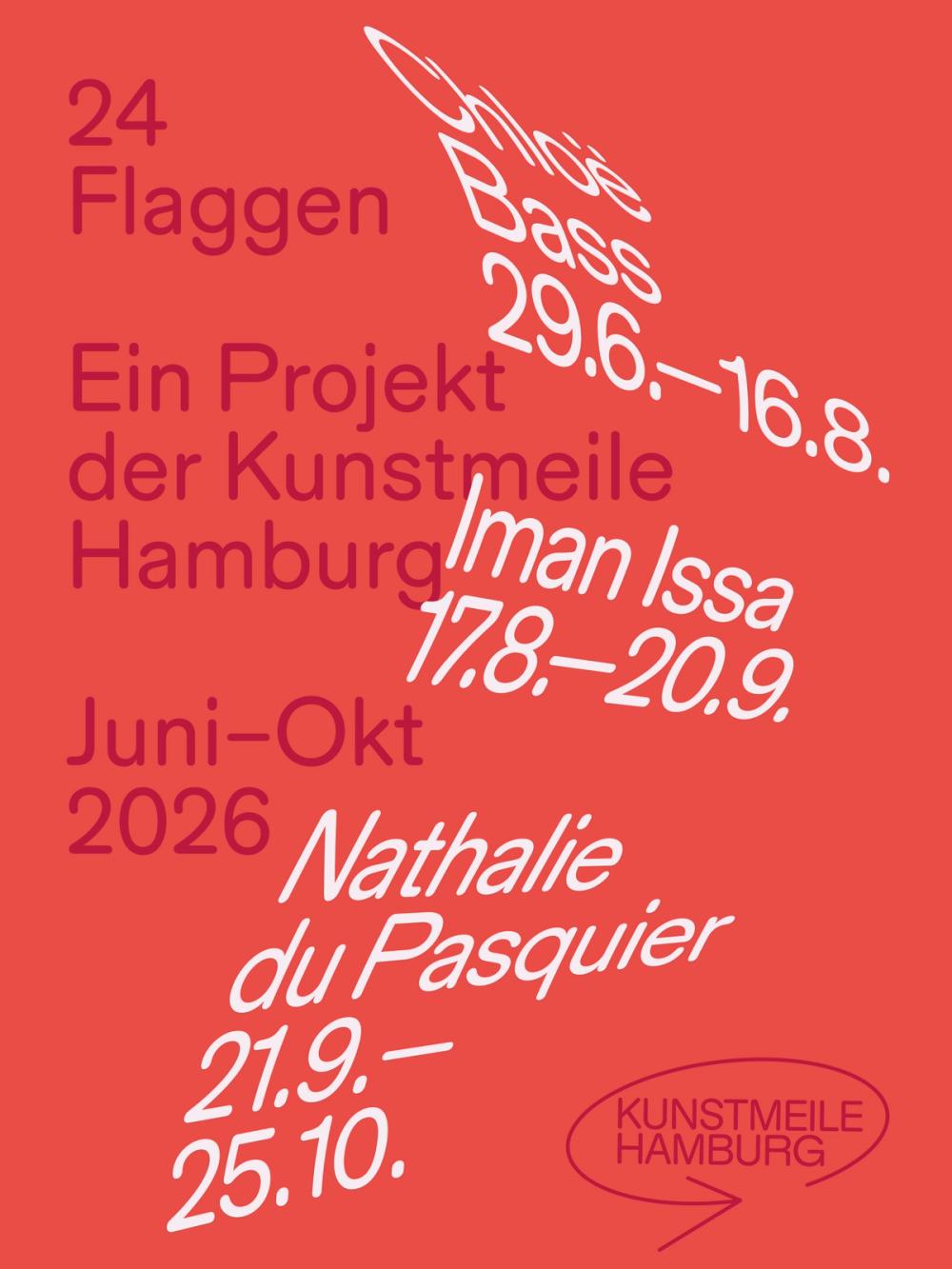
24 Flags – a Project by Kunstmeile Hamburg
June – October 2026
With the project 24 Flags, Kunstmeile Hamburg brings art into the public realm. Following its first edition last summer, the series returns with a second edition along the 24 flagpoles located around Glockengießerwall and Klosterwall.
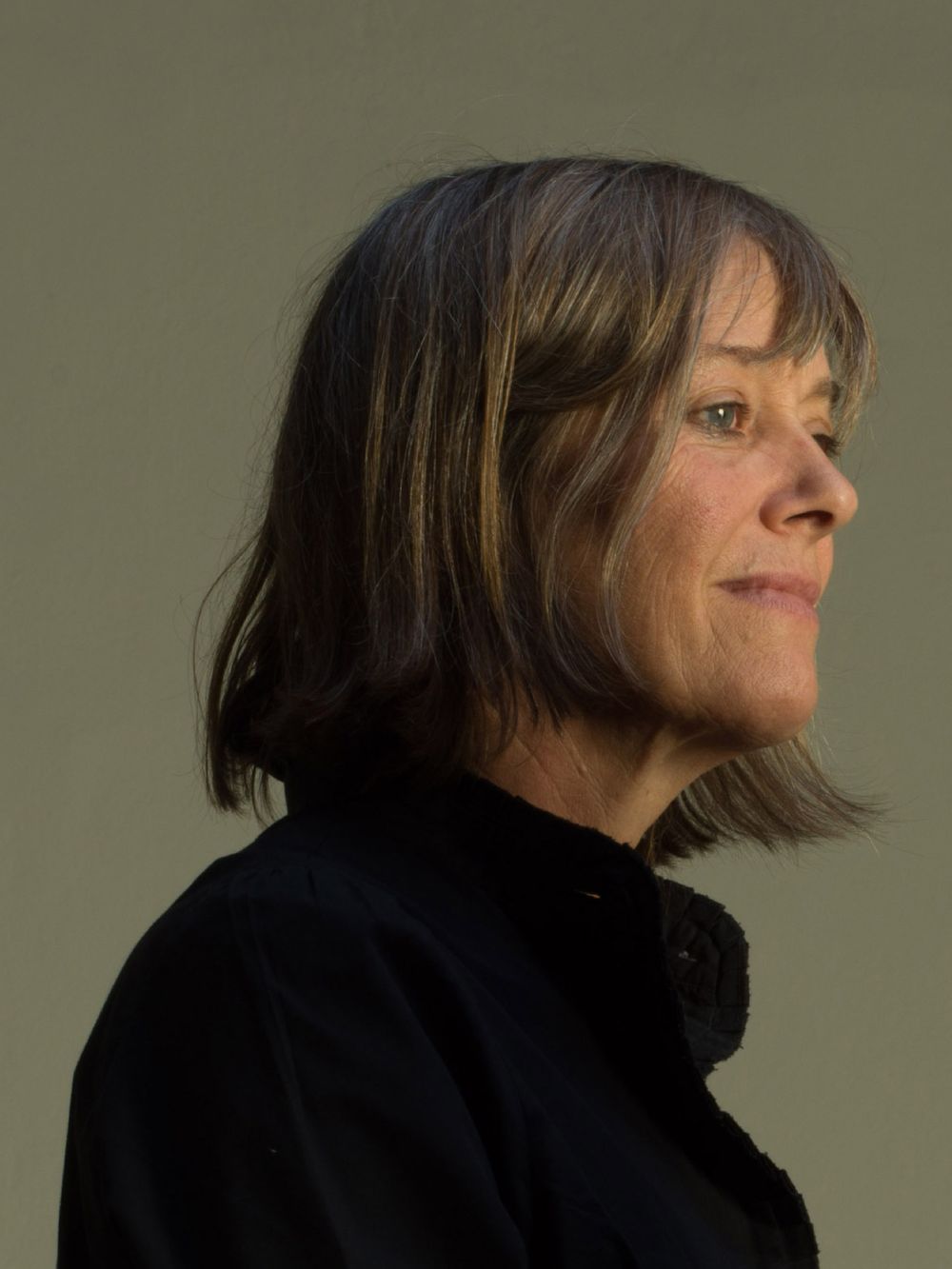
Flags are familiar features of the urban landscape, serving both as markers of orientation and as vehicles for images. Embedded within the visual fabric of the city, they appear here as artistic interventions. For this second edition, Chloë Bass, Iman Issa and Nathalie Du Pasquier have each developed site-specific works. What unites them is an interest in how meaning emerges through the interplay of context, arrangement and perception. Chloë Bass explores how intimate experiences are renegotiated within public and urban settings. Iman Issa brings together historical references, text and objects in new constellations, reflecting on the ways meaning is shaped through display and interpretation. Nathalie Du Pasquier works across painting, objects and installation, combining representational and abstract elements in dynamic spatial arrangements.
Jury: Corinne Diserens (Head of Contemporary Art & Exhibitions Curator
Art on Paper since 1960, Photography, Media, Hamburger Kunsthalle), Nadine Isabelle Henrich (Curator House of Photography & Head of the Centre for Visual Media, Deichtorhallen Hamburg) und Paul Grziwok (Project Management, Kunstmeile Hamburg)
Text: Katrin Krumm
Photos of flags: Lashproduction
Design Flyer: NODE Berlin Oslo
Timetable:
29.6. – 16.8. Chloë Bass
(in the meantime, from 20.7 to 3.8, the Hamburg Pride e.V. flags will be hanging.)
17.8. – 20.9. Iman Issa
21.9. – 25.10. Nathalie du Pasquier
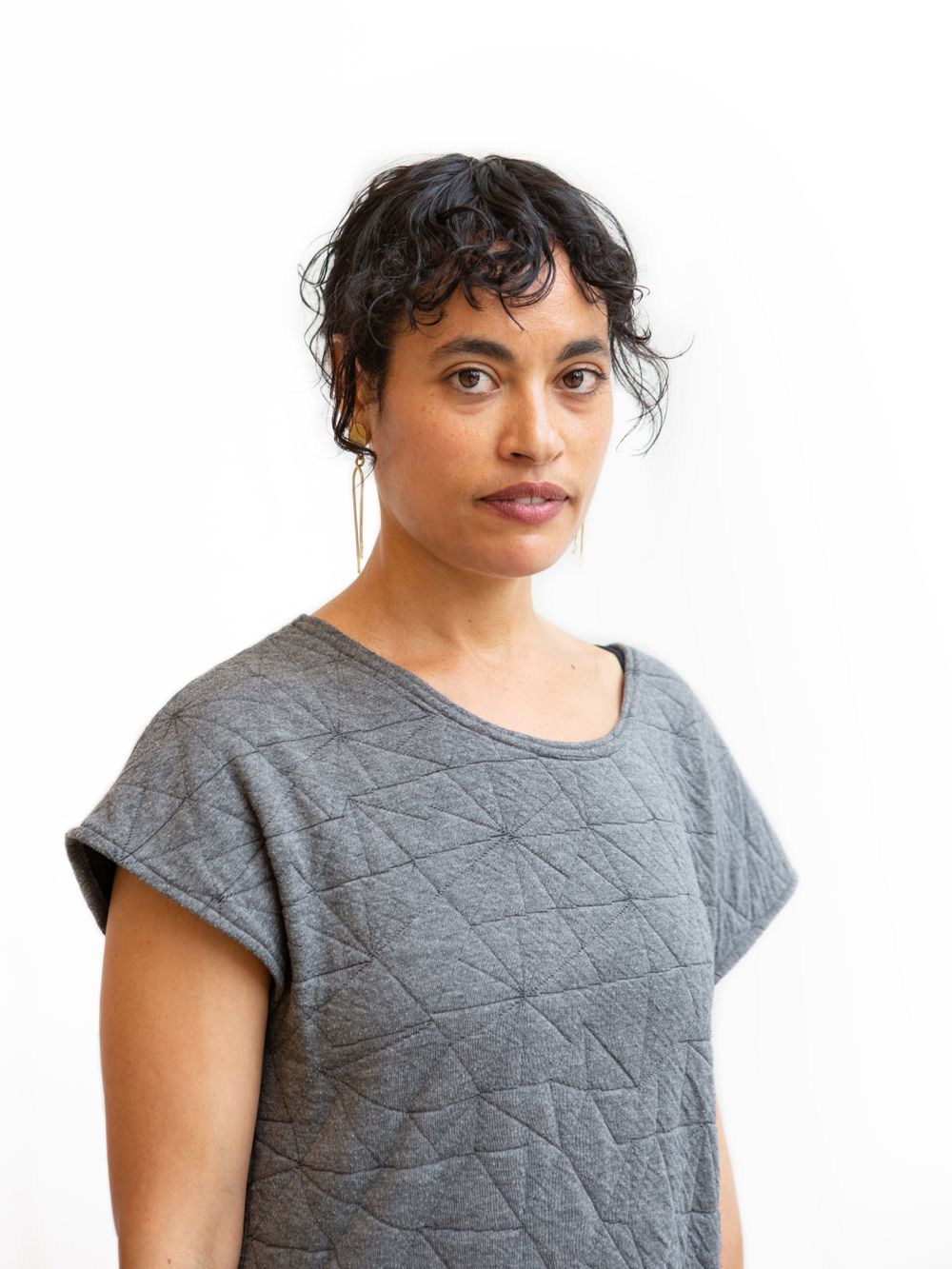
Chloë Bass
29.6 - 16.8
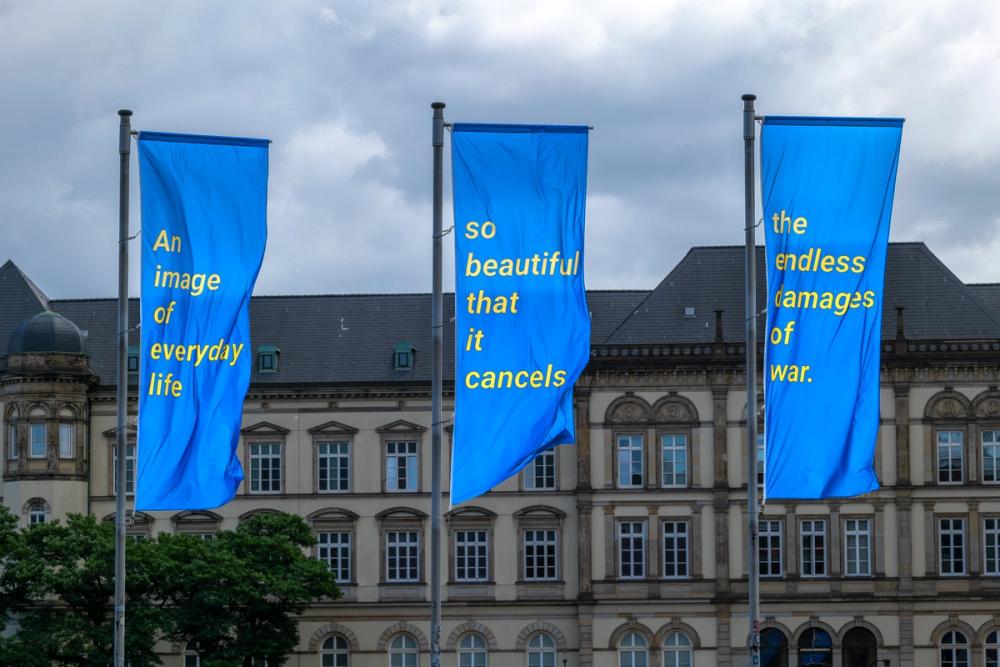
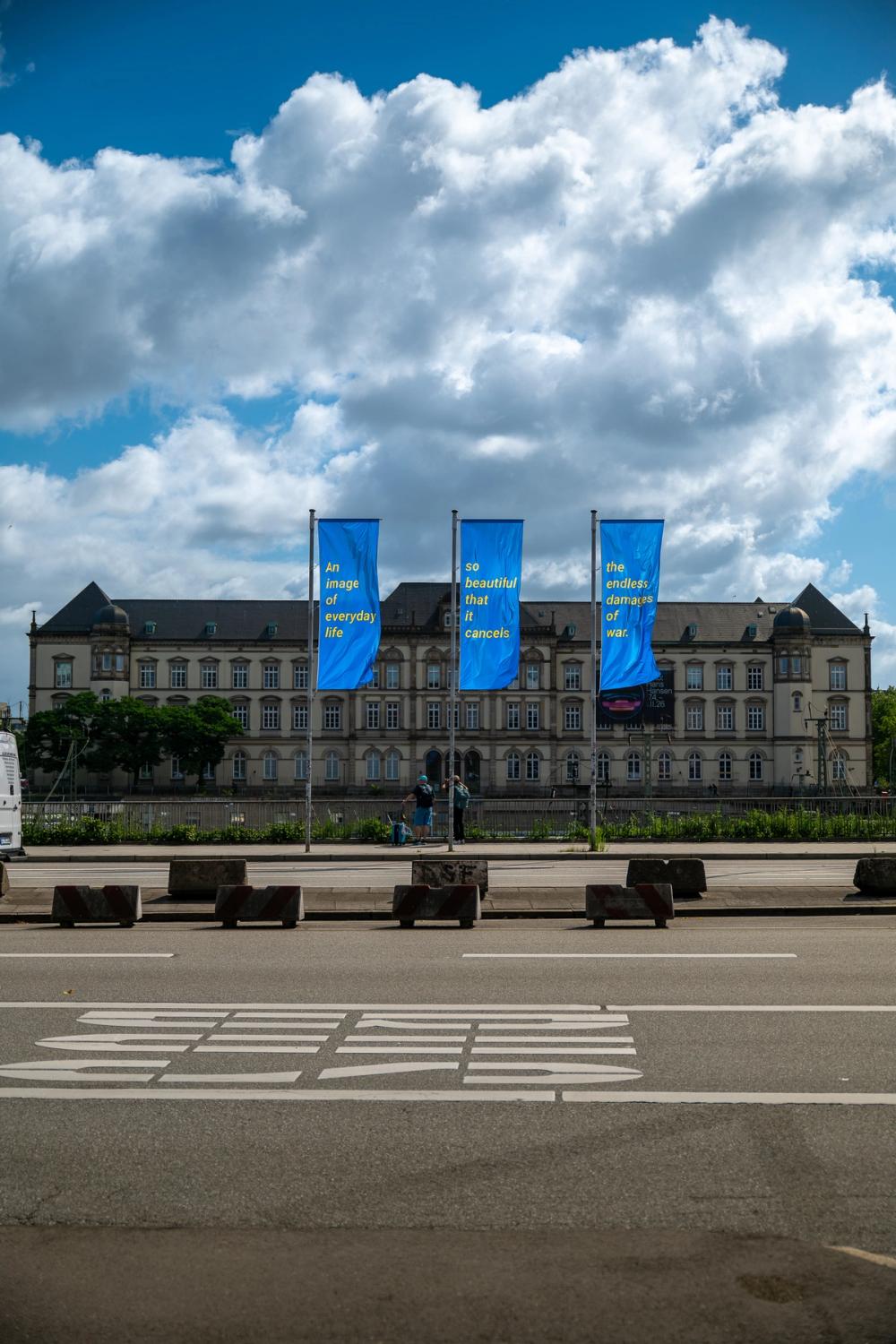
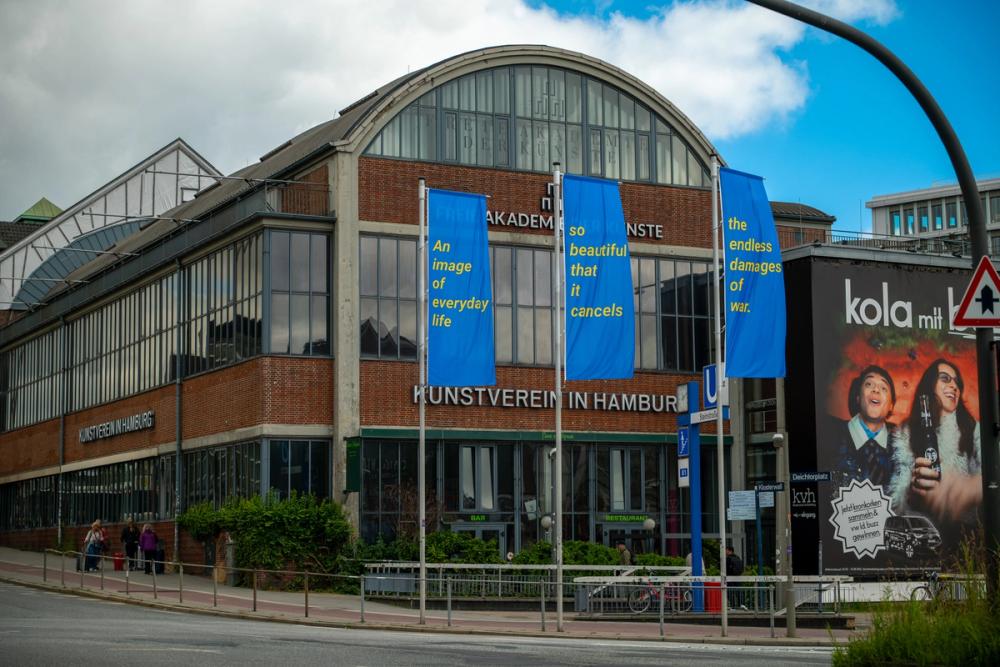
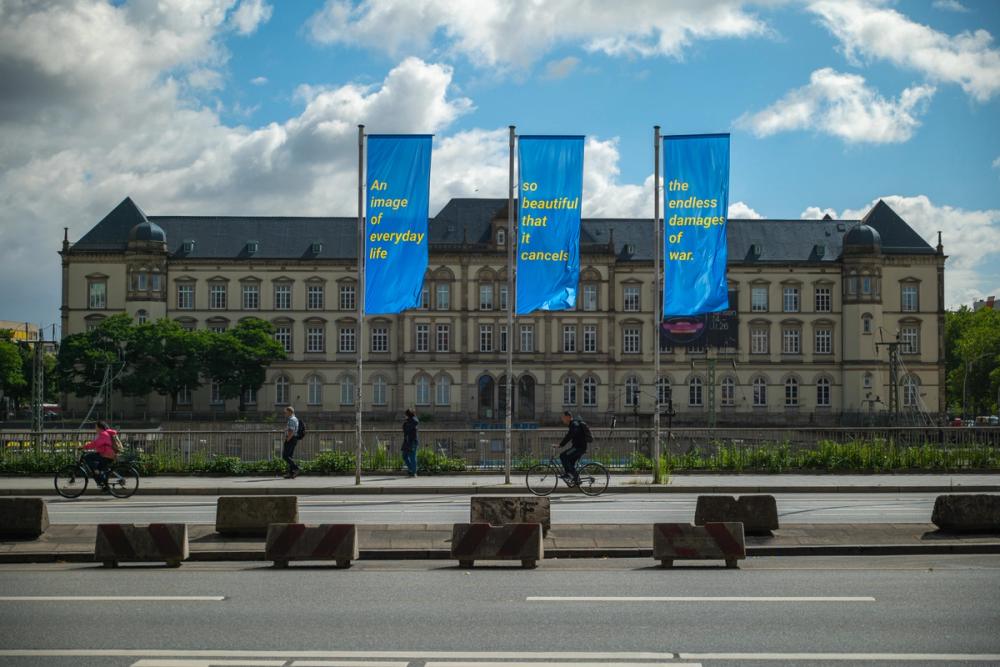
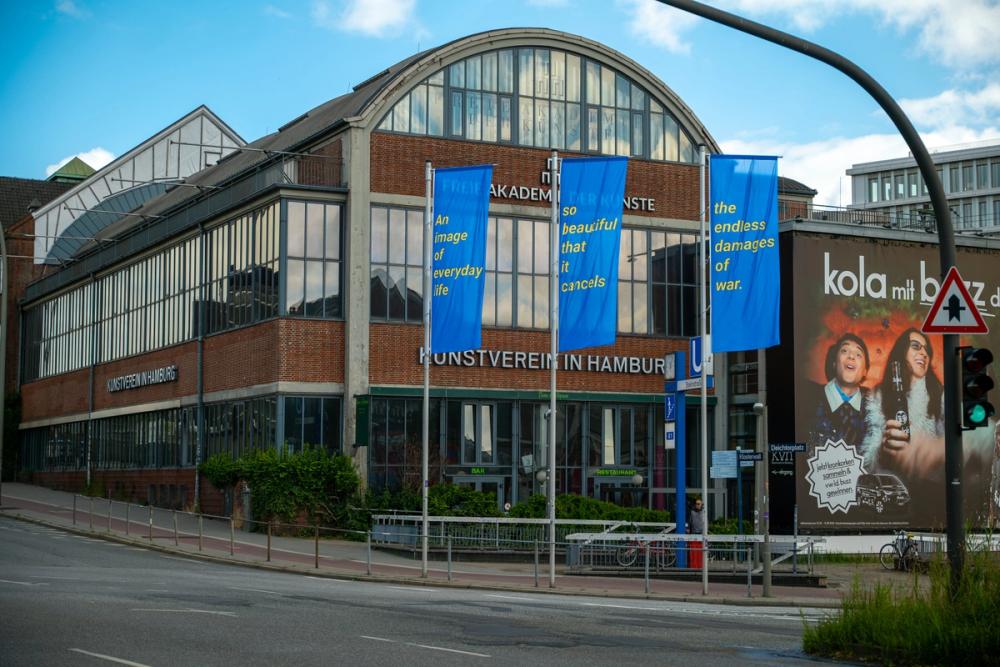
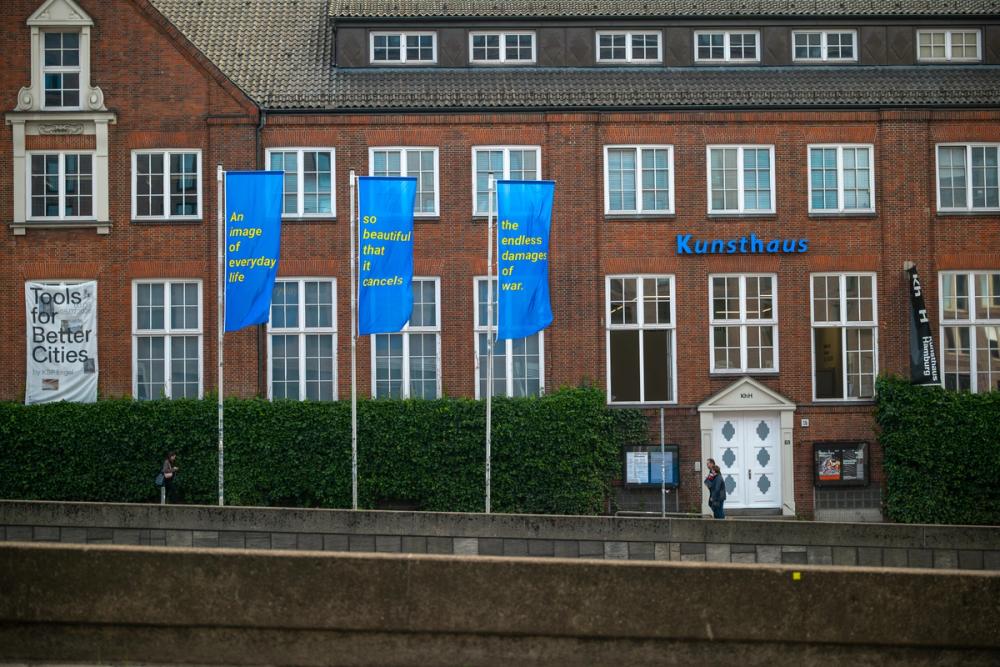
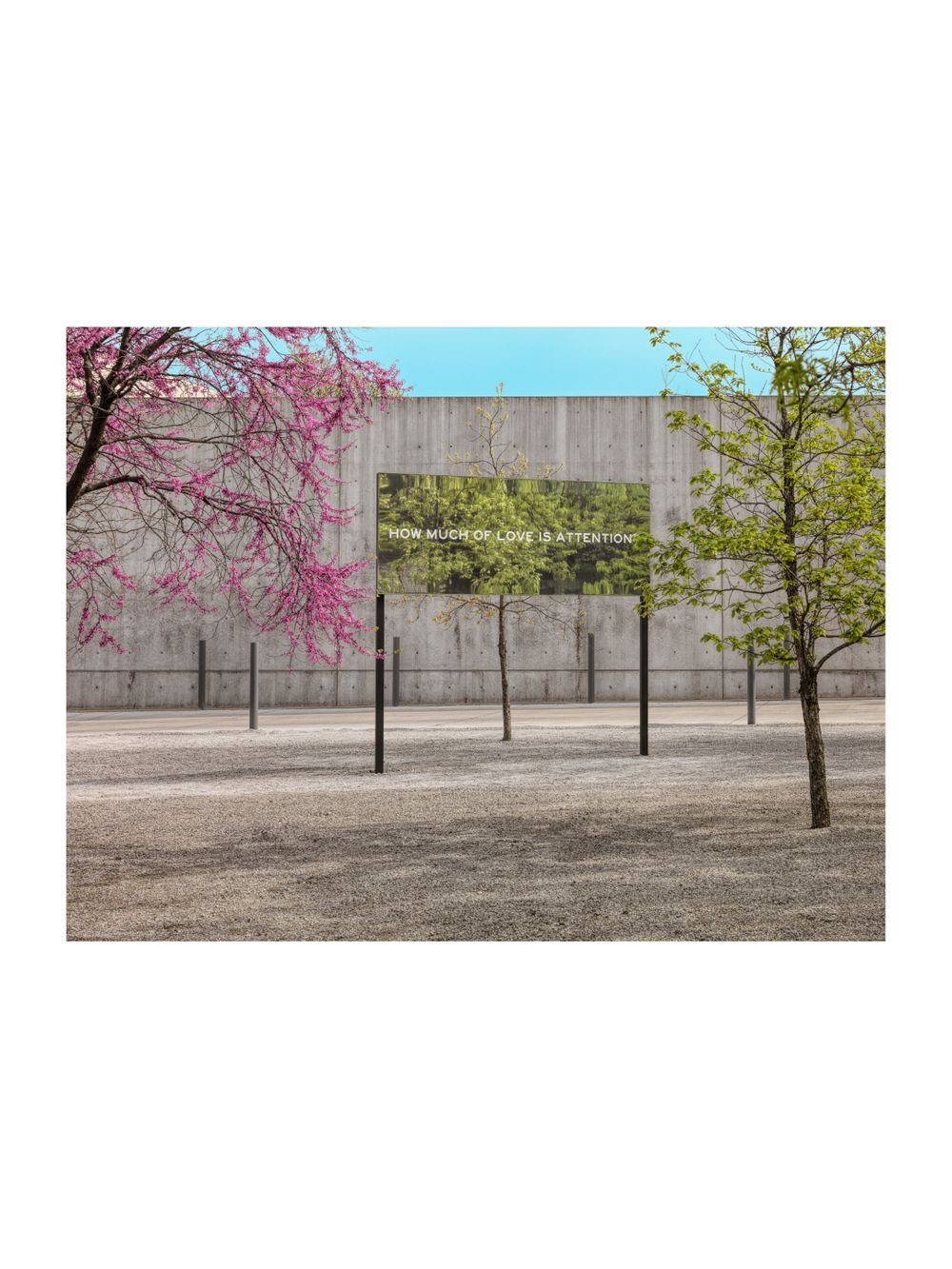
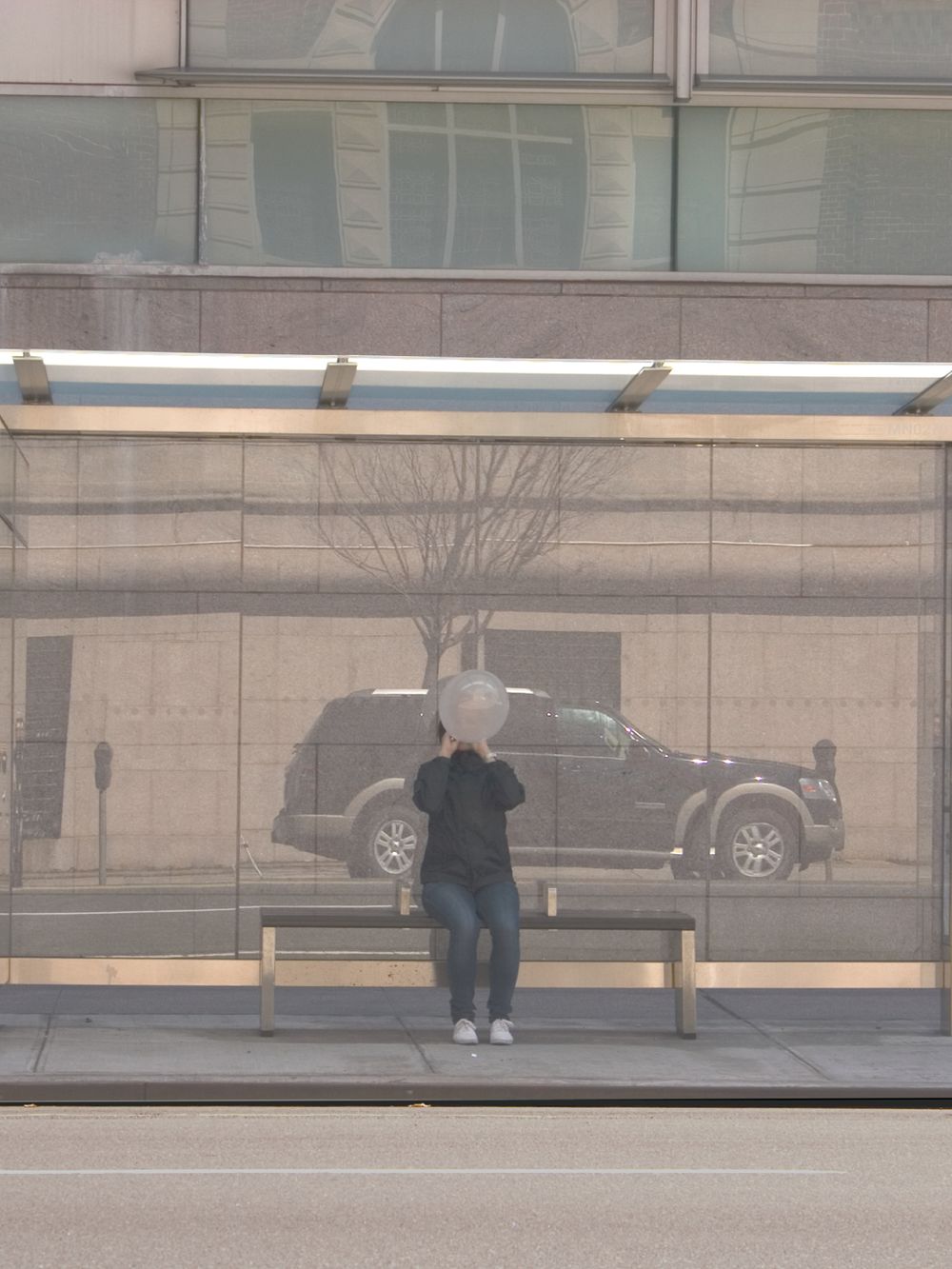
Chloë Bass’s artistic practice explores the relationship between intimacy and public life. Working across performance, installation, text, photography and sound, she examines the tensions that arise between the two. Her background in theatre and performance informs an approach that brings together language, the body, materials and architecture. Bass understands everyday situations as politically informative, translating them into works that are often site-specific. She is particularly interested in how personal experiences are shaped by and embedded within social structures and urban environments. Moving between her own perspective, intimate partnerships, family relationships and broader social and political contexts, she traces connections across different scales of human experience. Public spaces often provide a concrete setting for these investigations. Her works create room for reflection and orientation, while affirming the public realm as a shared space shaped by those who inhabit it. (Katrin Krumm)
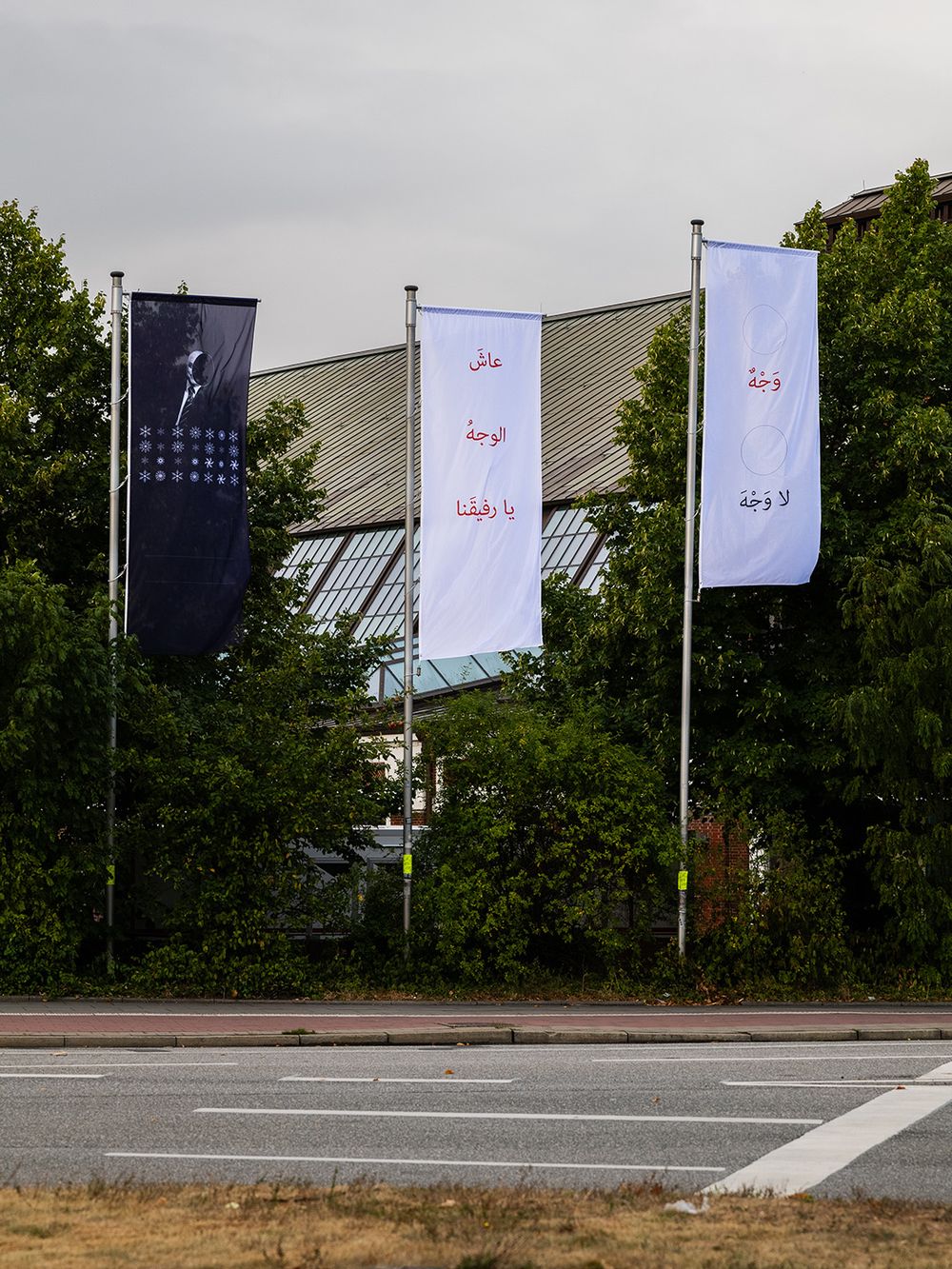
Chloë Bass’s text-based work uses a sequence of three flags at a time to open up a dissonant space of the imagination: an image of everyday life so beautiful that it puts a stop to the endless destruction of war. In doing so, Bass chooses the ambivalent word ‘cancel’, which can also refer to censorship practices and the erasure of unwanted perspectives on social media. Perception and reality operate in algorithmic attention economies in an increasingly dissonant or detached manner. In an algorithmically organised feed, a war can lose its ability to capture attention, whilst the visibility of uncomfortable narratives can be deliberately reduced by platforms. The daily visual experience in the feed, where depictions of carefree everyday life exist side by side with images of conflict, is condensed into a formulaic form in Bass’s work. Conversely, this brings into sharp relief the realisation of an impossible everyday existence amidst the turmoil of war. The composition, consisting of three sets of five words stacked one above the other, also allows for cross-references: ‘image – beautiful – endless’ and ‘life – cancels – war’. Bass also evokes a utopian potential and implicitly raises the question of the extent to which an image of great beauty can create a positive vision that counteracts the narratives of enmity. (Nadine Isabelle Henrich)
Chloë Bass: “This series of three flags asks us to imagine something beautiful but impossible. What single image from daily life could cancel the damages of war? It's an optimistic idea, one that might inspire us to make more beauty in our own lives. However, it also asks us to remember that the production of beauty on a local basis is not sufficient to cancel larger-scale harms worldwide. An image, no matter how beautiful, is just the representation of a moment. It is not an act, or series of actions, that produces repair, even if we continue to hope that beauty will change the world.”
Iman Issa
17.8 – 20.9.
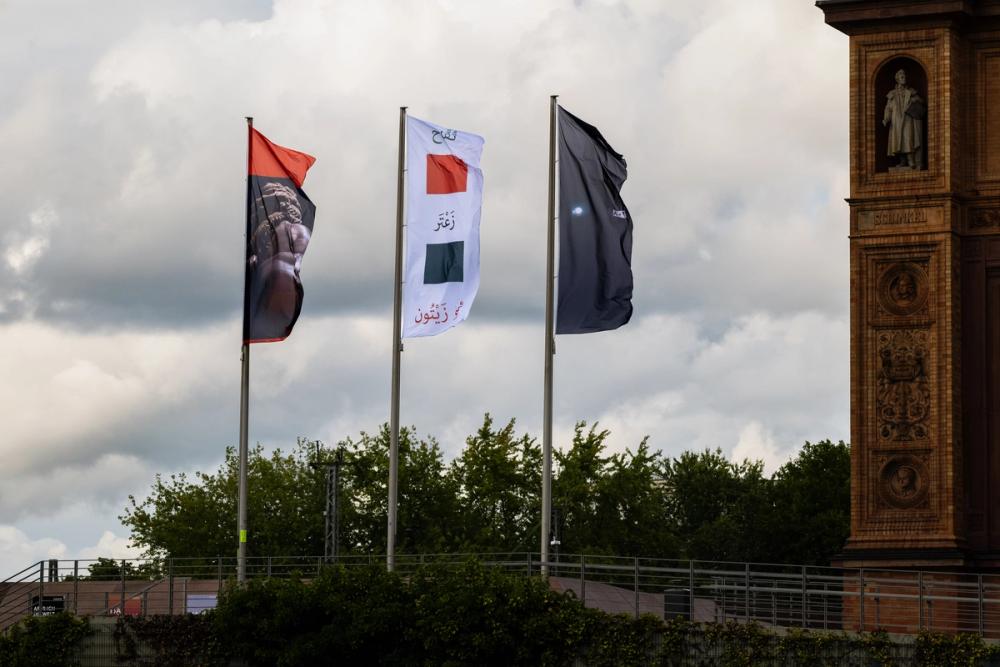
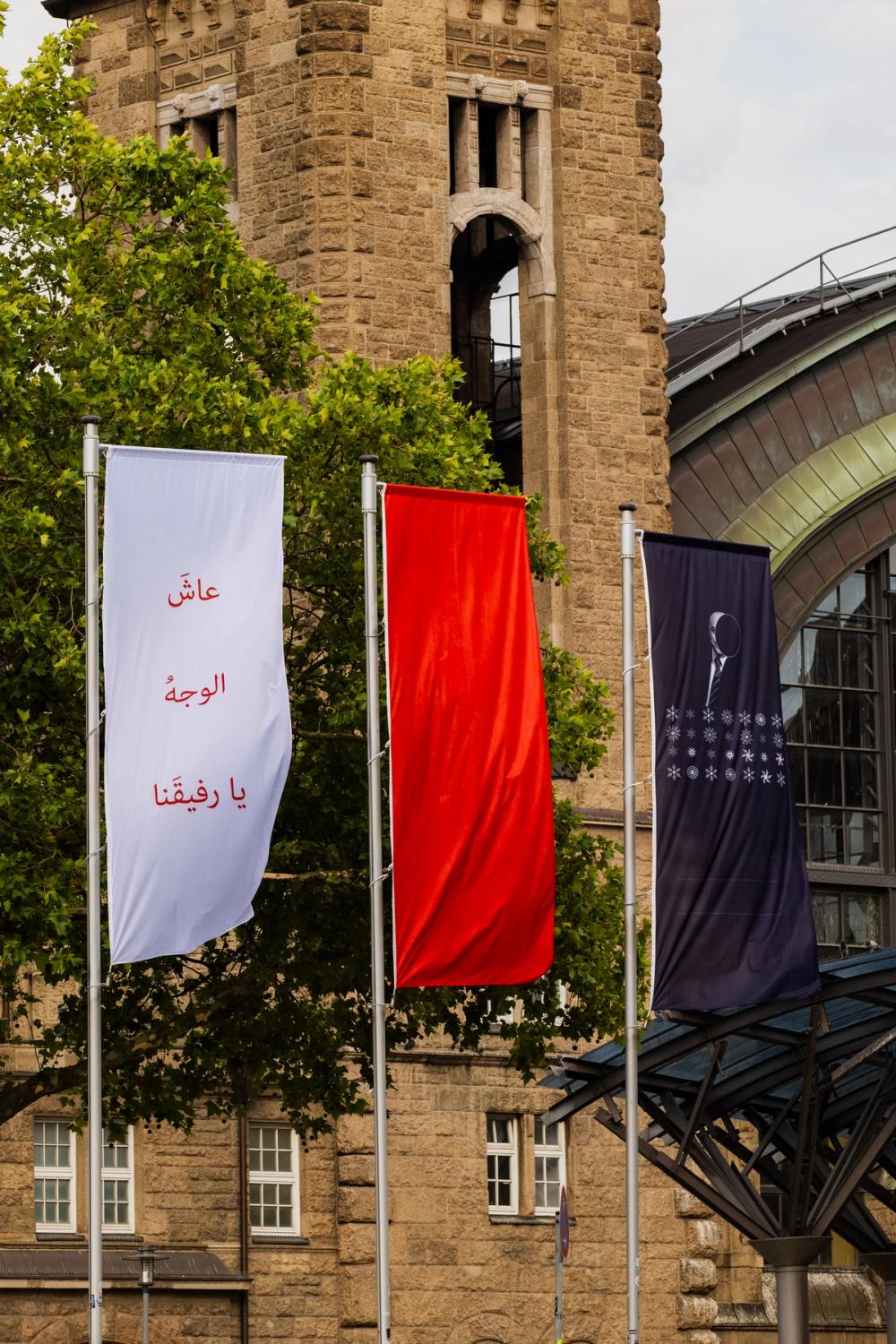
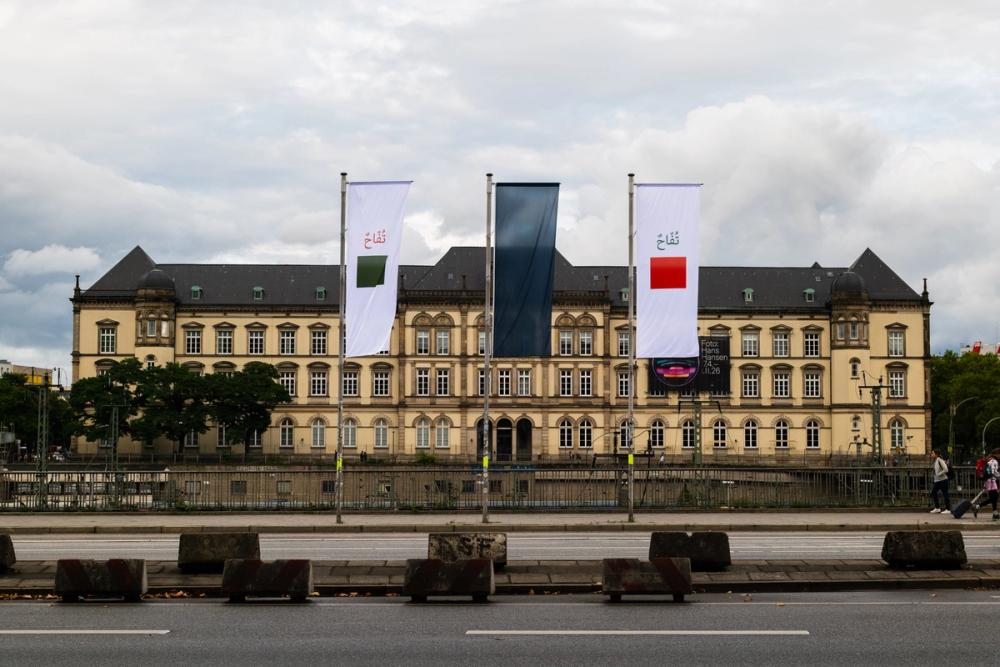
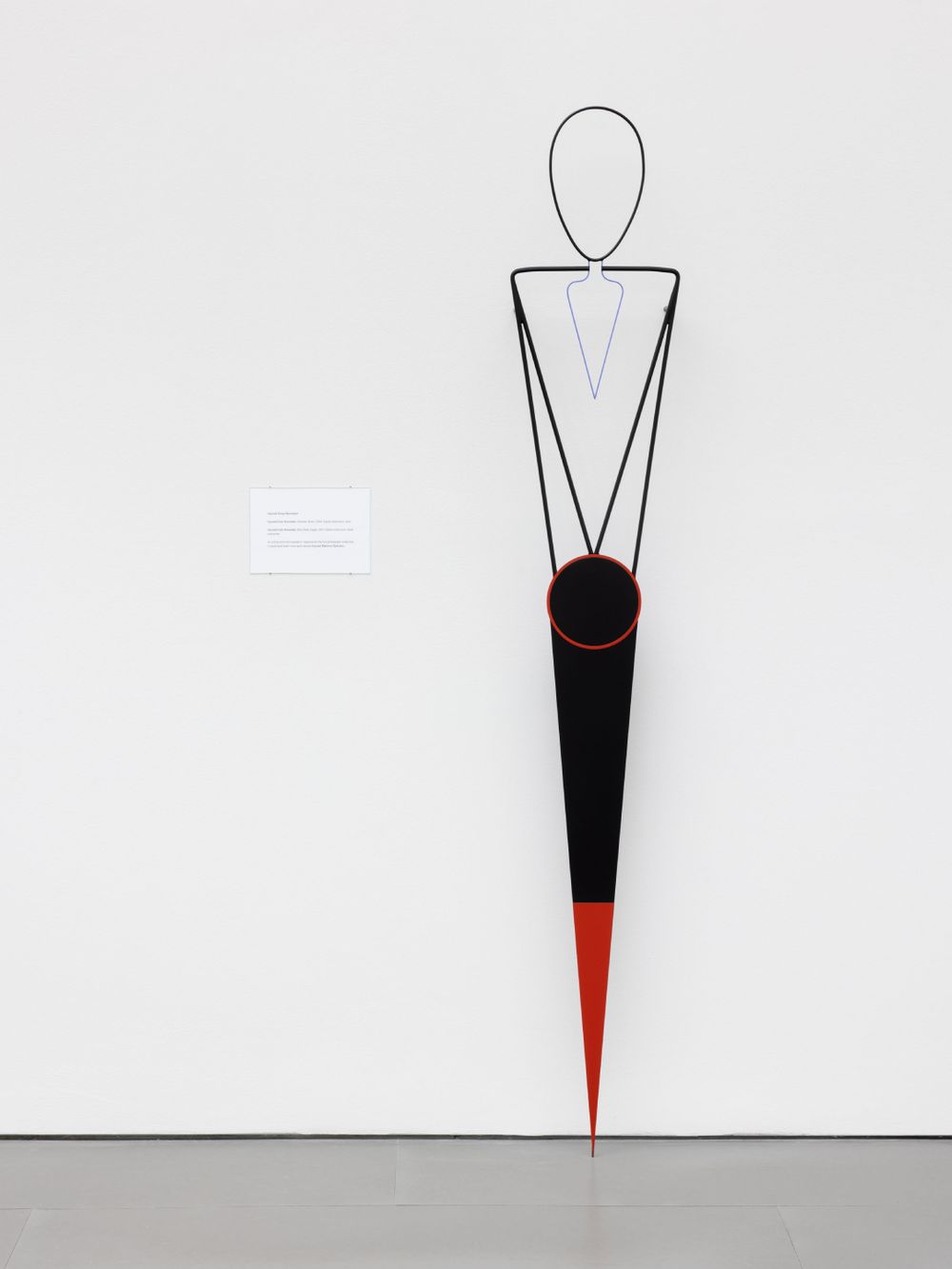
At the heart of Iman Issa’s artistic practice lies the question of how meaning arises and is conveyed. Through sculpture, photography, text, video and sound, she develops ‘displays’ – arrangements in which objects, images and texts converge at the intersections of perception, memory and institutional context. Meaning does not appear here as a fixed property of things, but as the result of the relationships between their elements and the viewers’ perception.
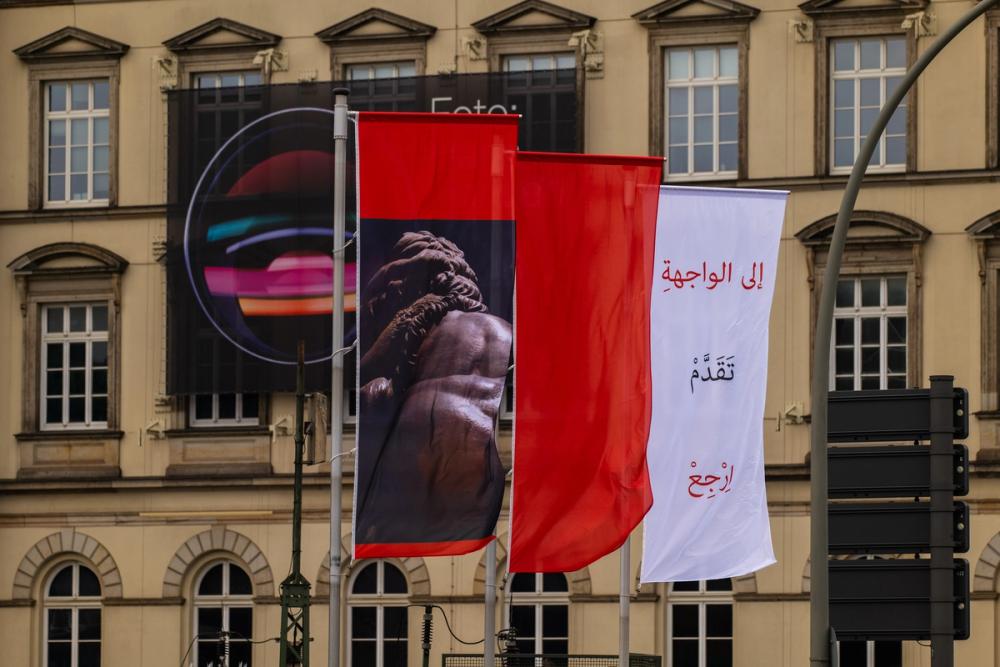
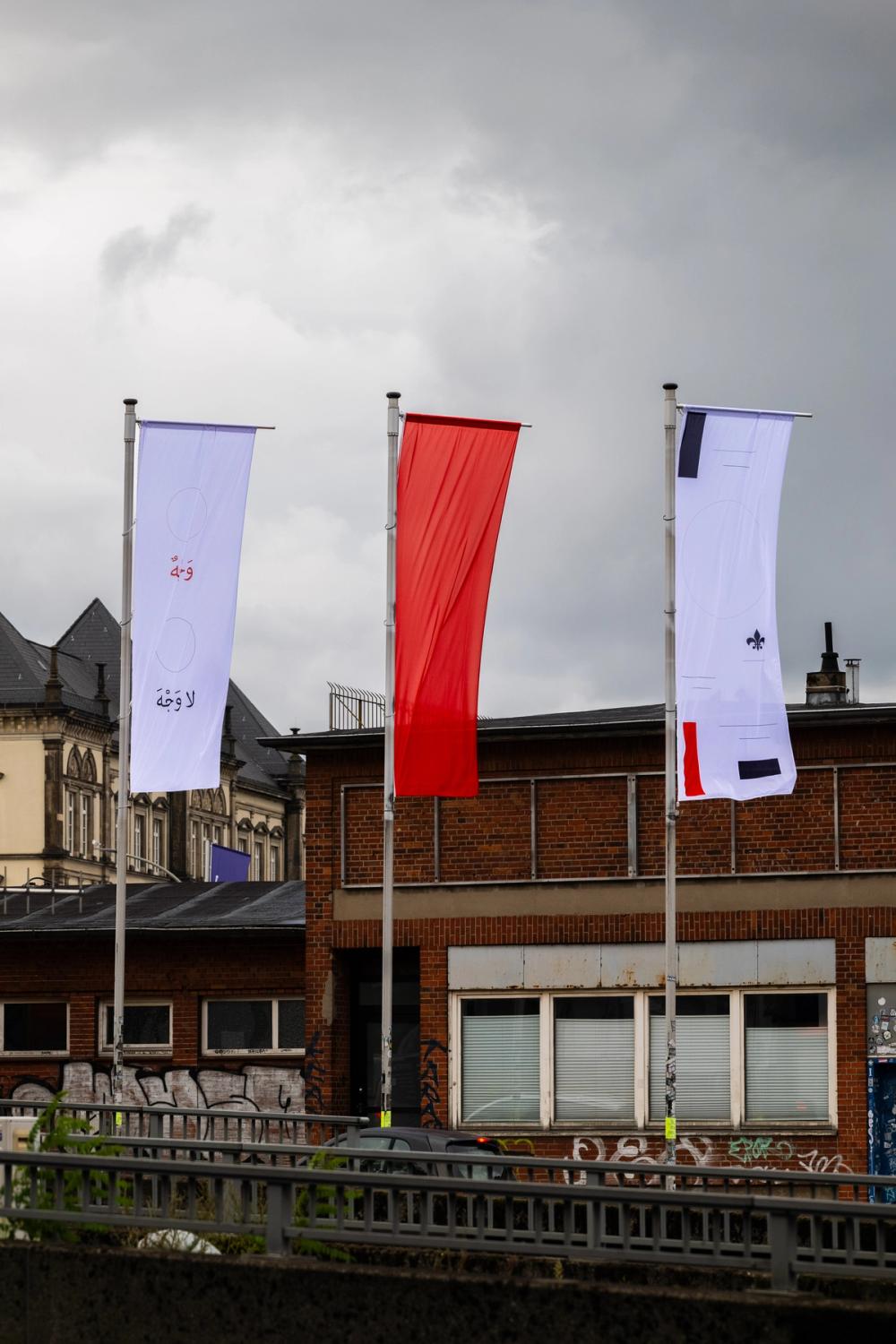
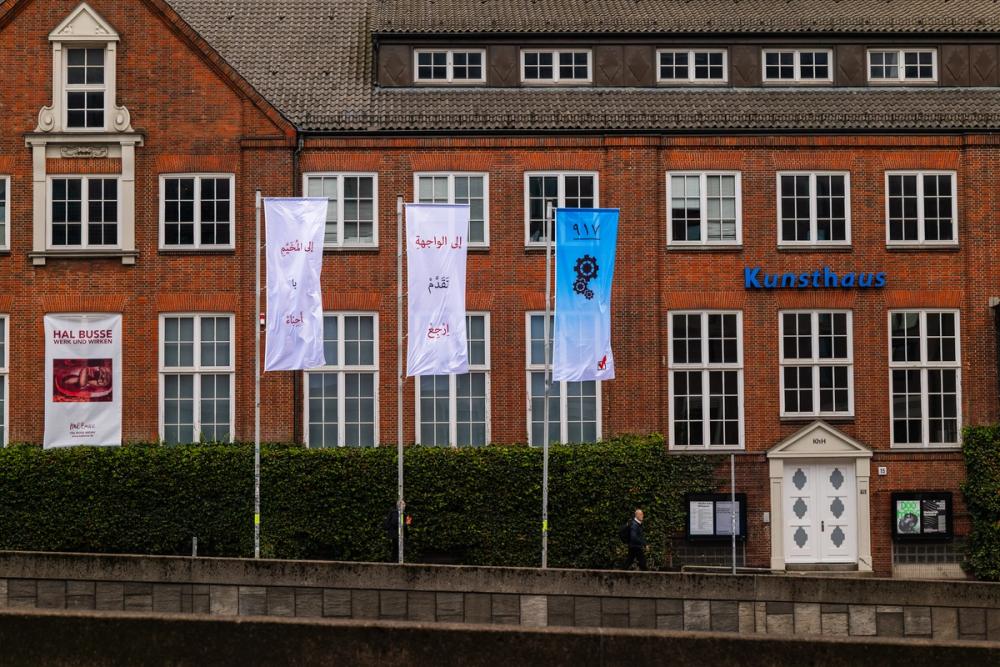
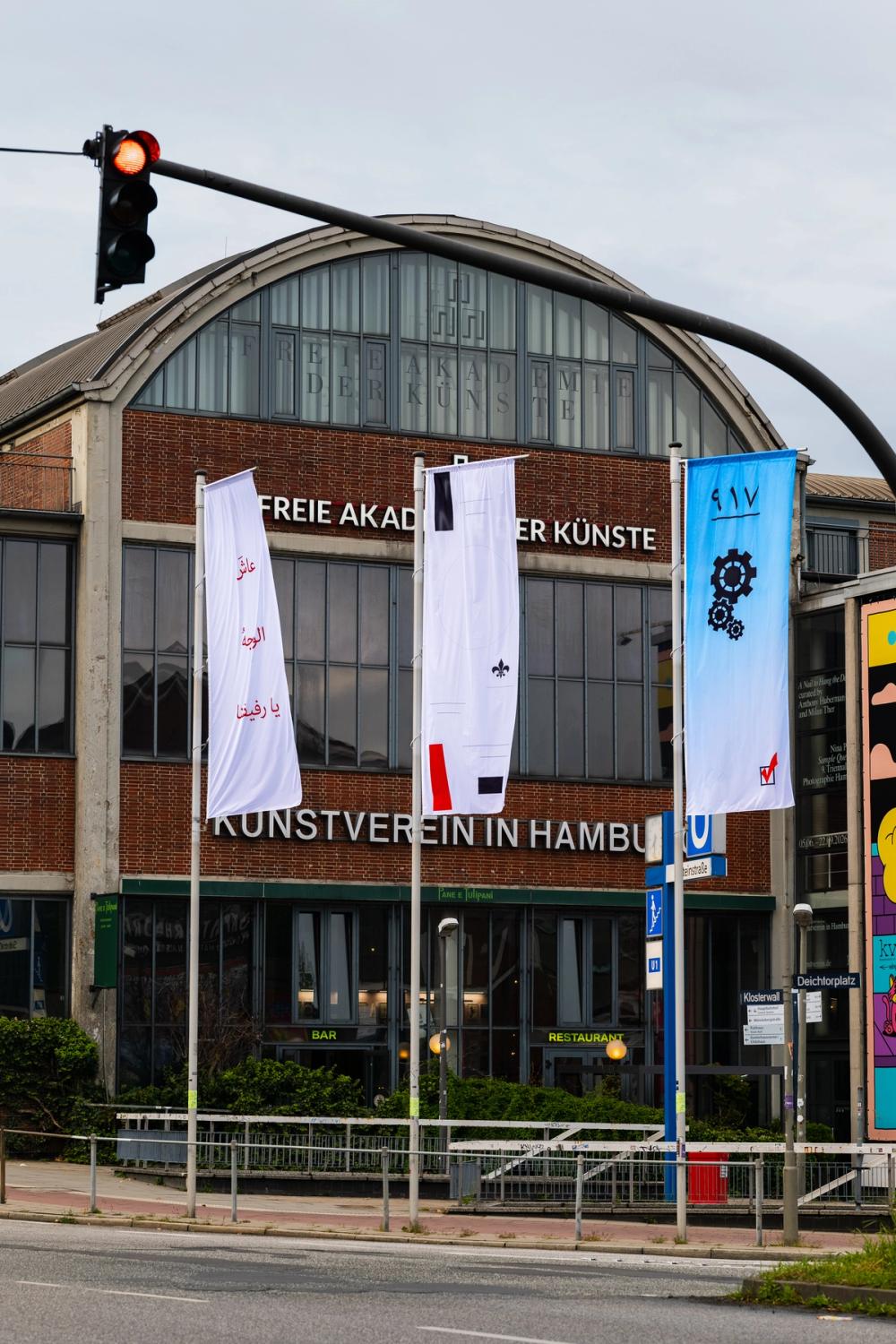
Brief a den, der hinschaut (Germany 2026) extends these questions into the public space. Spread across the urban landscape, the work consists of 24 flags that combine Arabic words, blocks of colour, numbers, shapes, symbols and fragments of images to form independent compositions. Rather than dictating a single interpretation, the work invites viewers to derive meaning from the relationships between the individual elements and their own perception. (Jasmin Holtkötter)
Iman Issa: „The project is constructed as a letter that unfolds over 24 flags. The letter is divided into 8 independent sections, each of which includes 3 flags, all addressed to the one interested in reading them. The flags are spread out throughout the city. A viewer can decide to read them sequentially or to contend with reading only one section. They include images, colors, texts, geometric forms and other patterns. All the texts are in Arabic, with no available translation, yet whether one is able to decipher the meaning of the section of the letter they help compose remains independent from whether one understands the language or not. The premise is derived from the theory of viewing by Ibn al-Haytham. To Ibn al-Haytham, there was no real distinction between images, texts, forms and patterns. Once the distance of images to the world was well-established, then their manner of operation became no different that that of a text and vice versa. To him, perception was an active process, where the shape of a word and its color, or the conceptual resonances of an image were both essential to their interpretation. Leaning on his thoughts, this letter has been written and now it is up to its reader or more precisely to follow his logic, its onlooker to give it meaning (or not).
Nathalie du Pasquier
21.9 – 25.10.
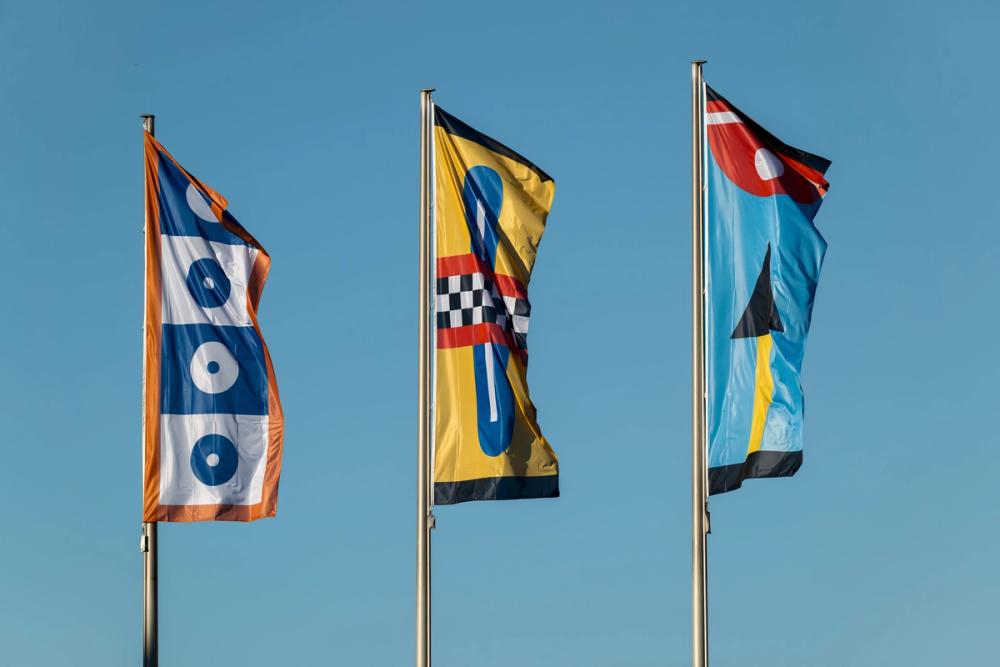
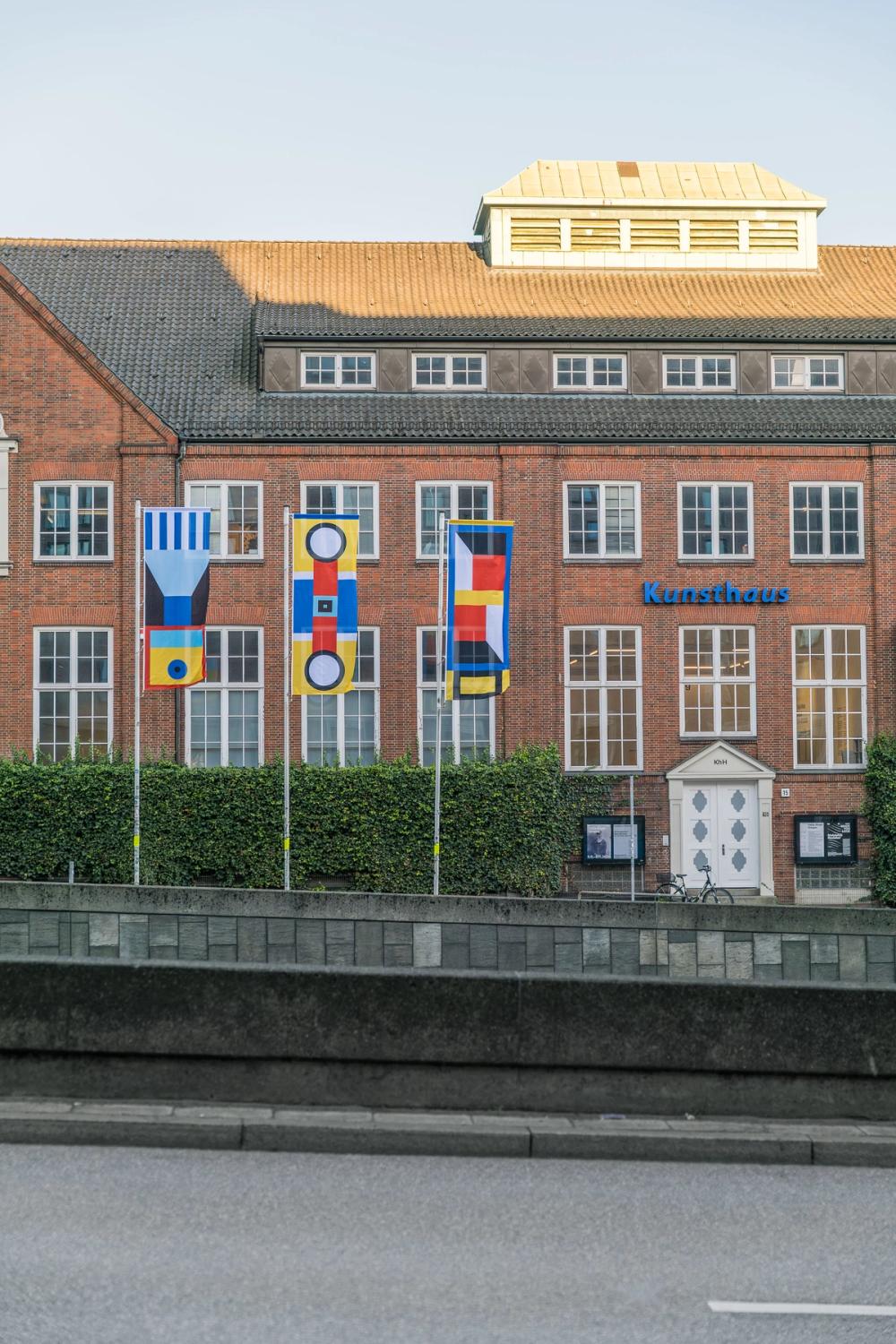
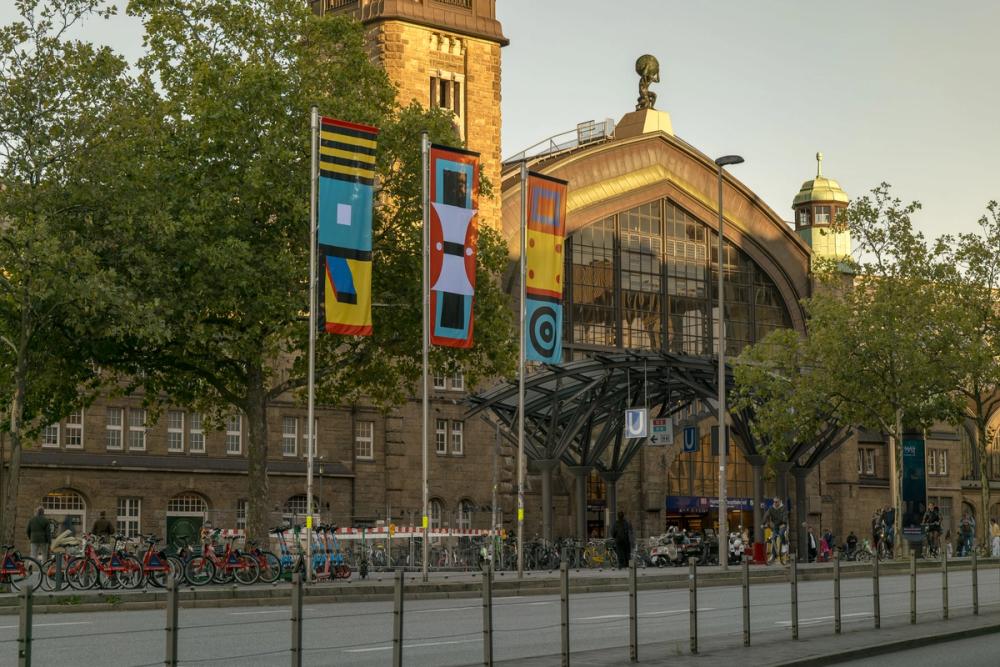
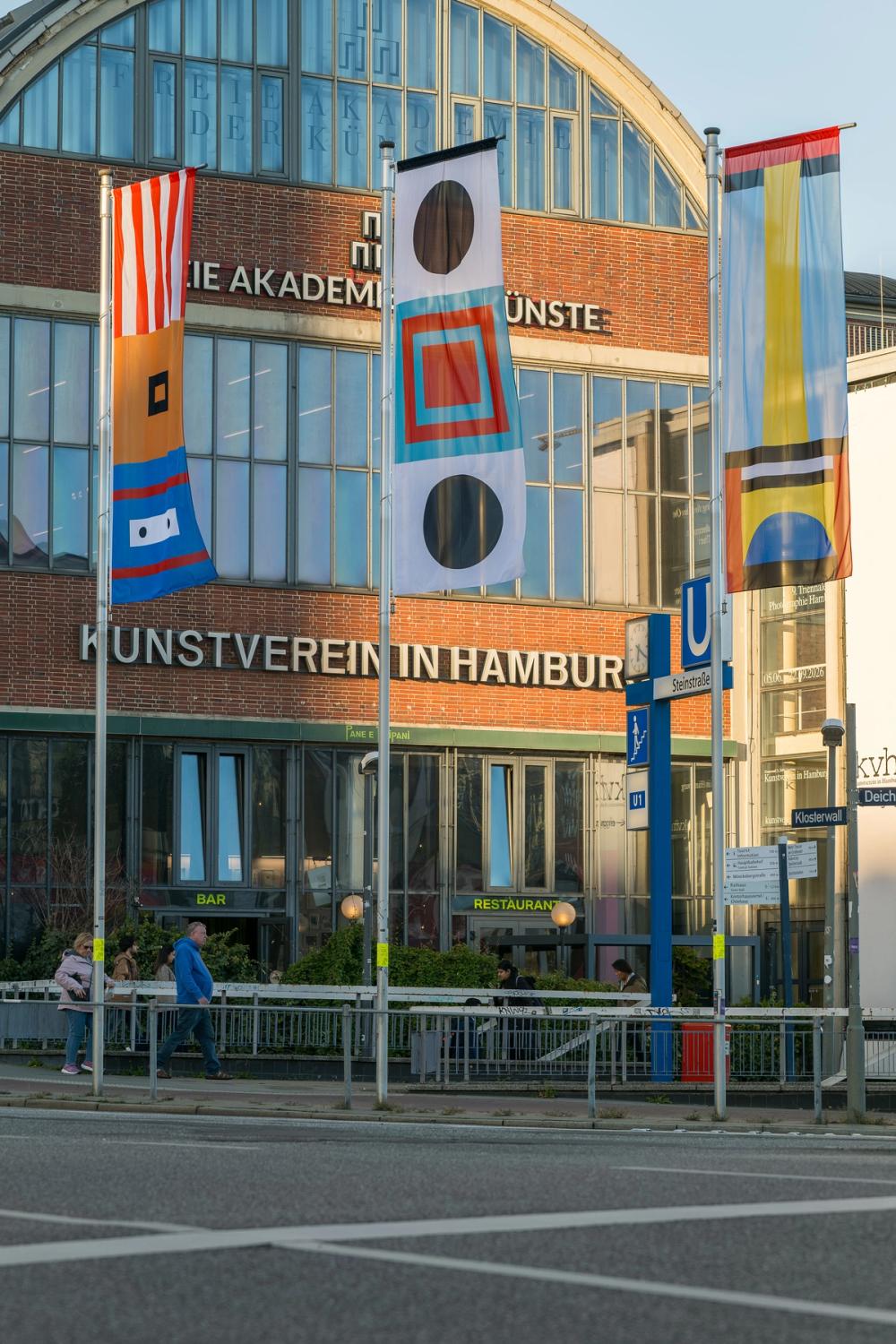
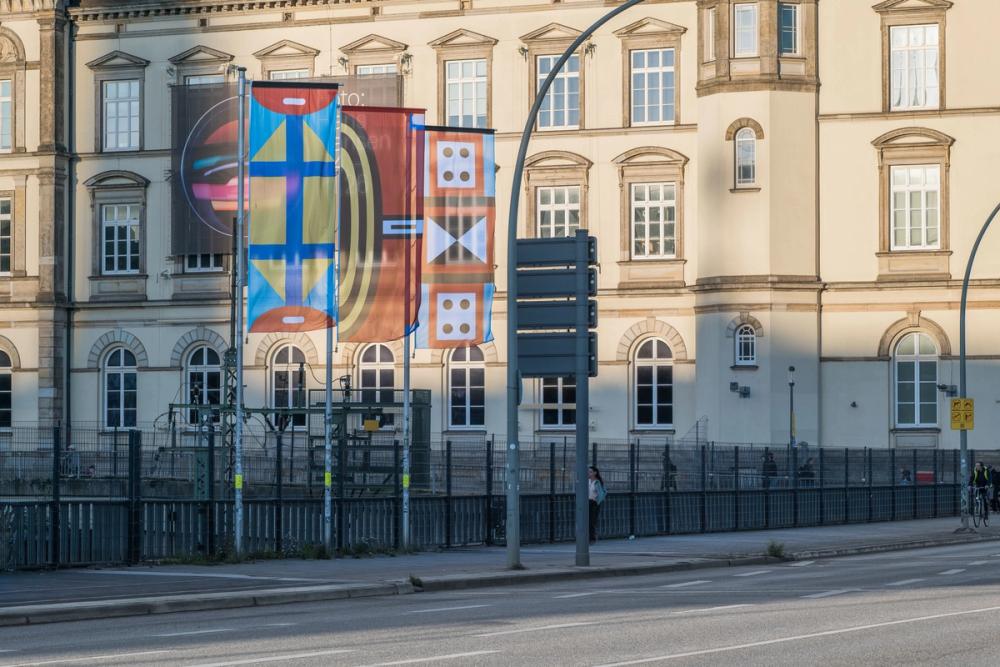
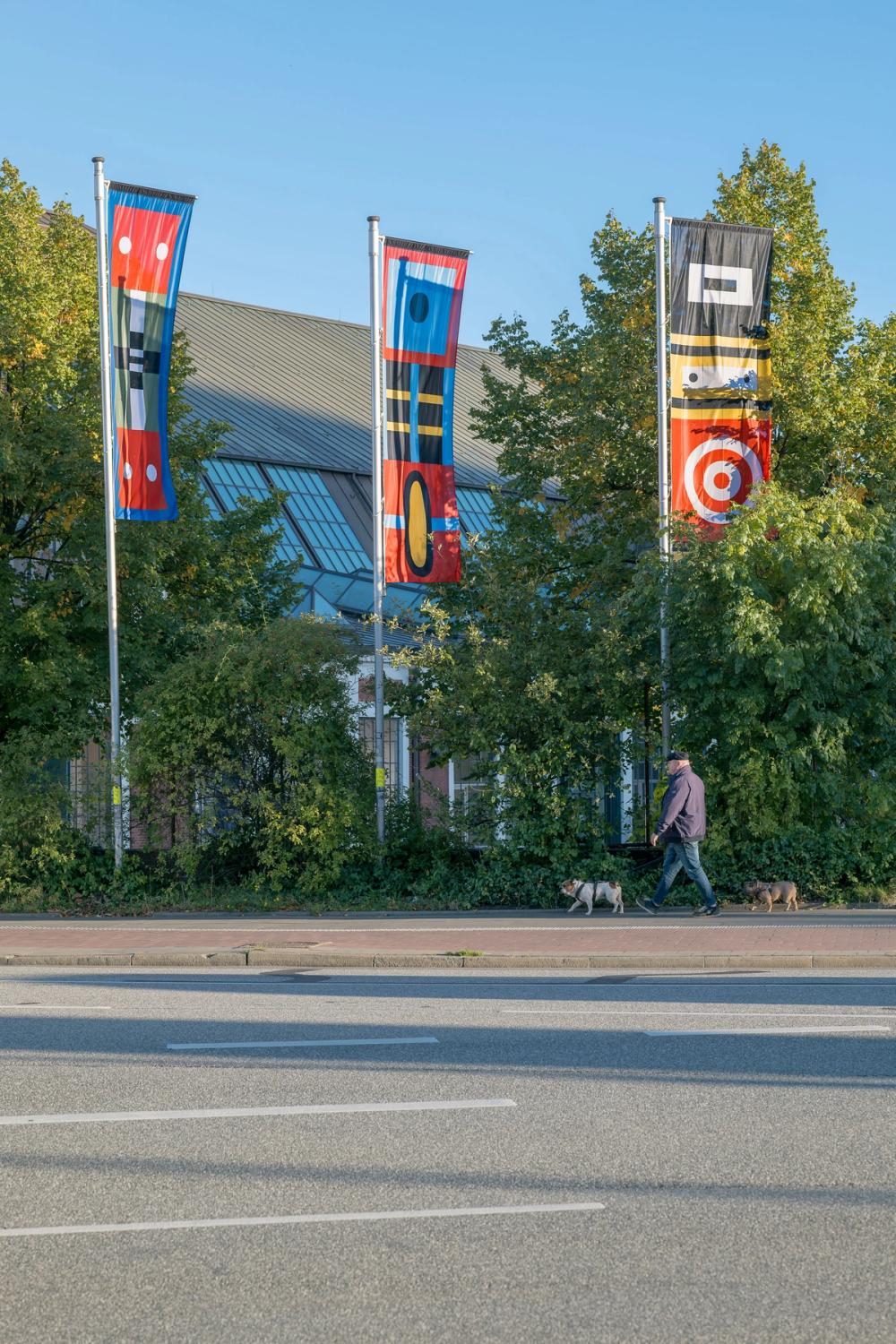
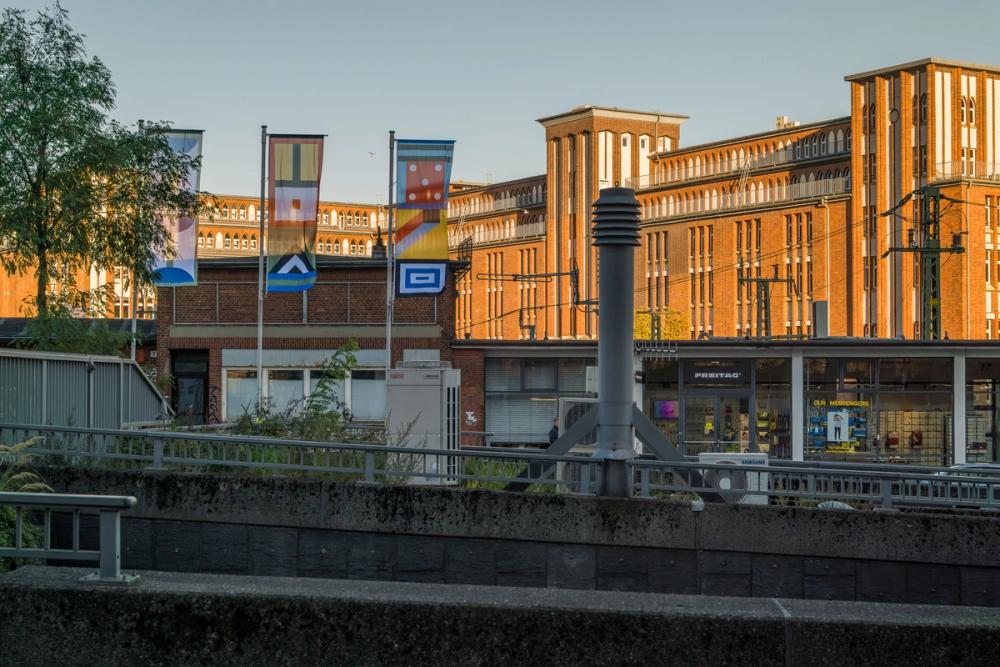
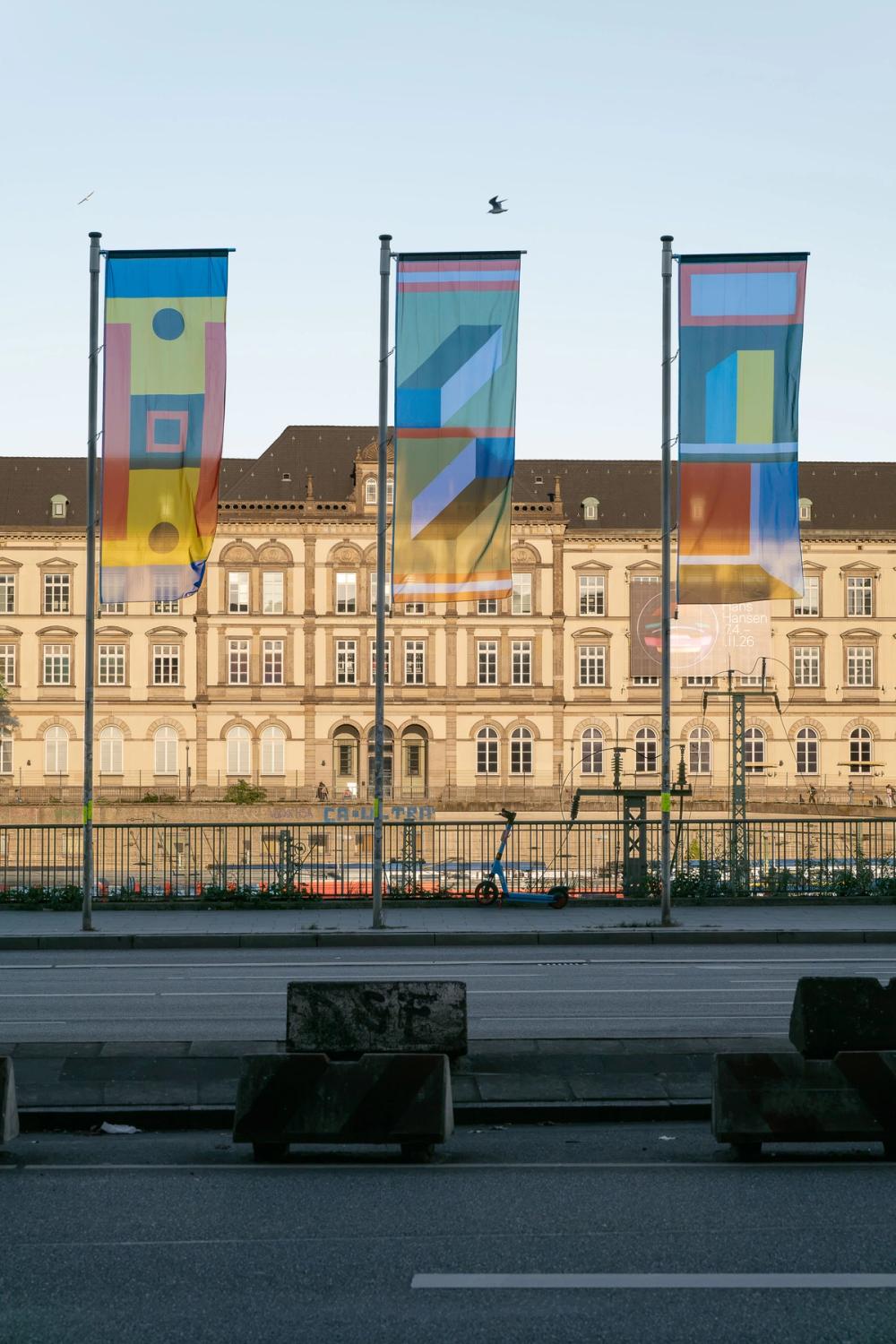
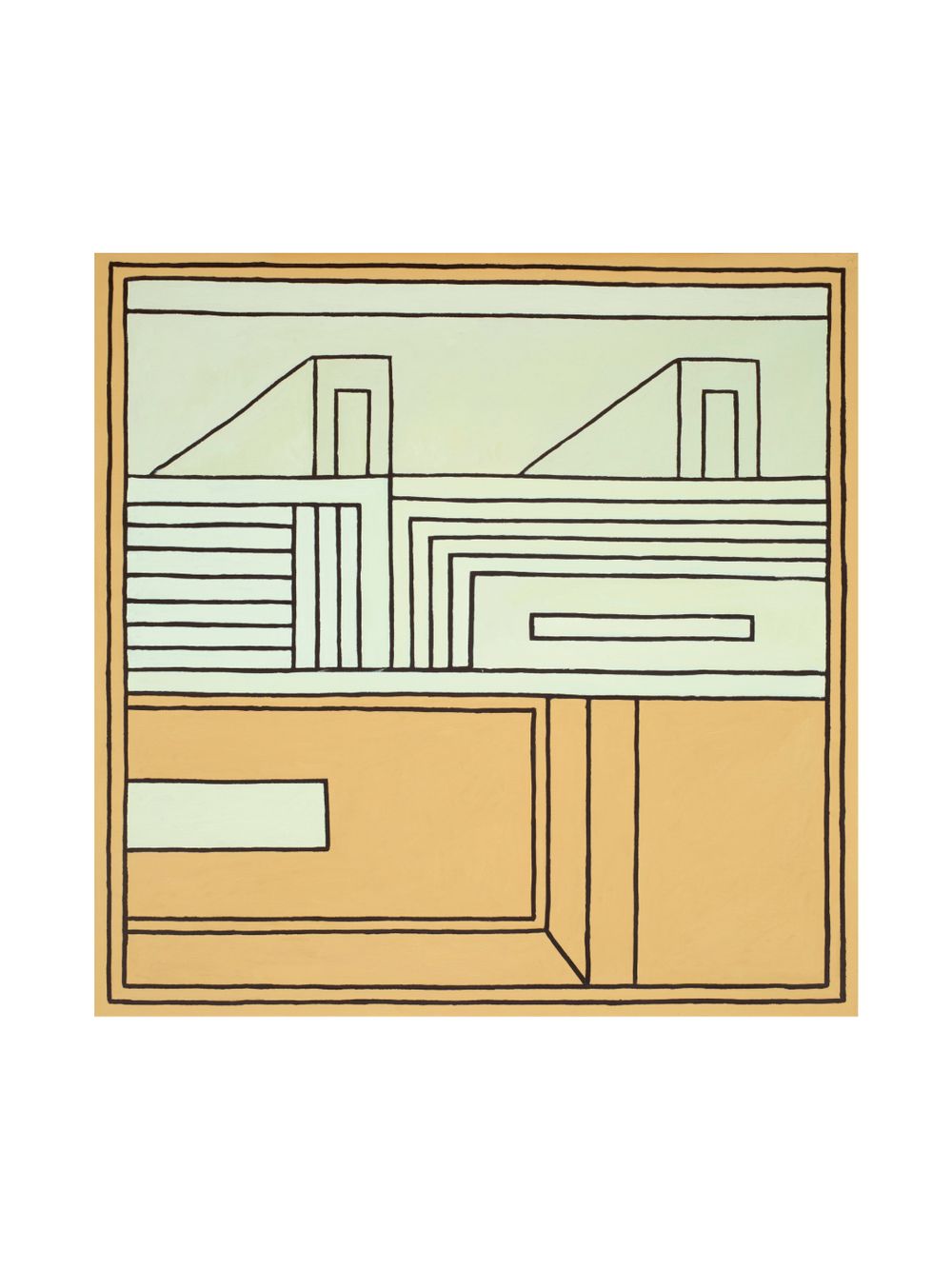
Dynamic geometric forms sit at the heart of Nathalie Du Pasquier’s visual worlds. A founding member of the Memphis Group, the Italian design collective, she spent the 1980s creating vividly coloured patterns, textiles, furniture and household objects. Since then, her practice has moved fluidly between a wide range of media and formats. Du Pasquier is particularly interested in the relationship between two-dimensional surfaces and three-dimensional structures, bringing together painting, ceramics, textiles, construction and installation in vibrant spatial compositions. Her still lifes take the form of playful yet layered constellations of shapes, colours and objects that move between representation and abstraction. Underpinning them is a sustained fascination with things themselves. Sculptural objects and object-like sculptures emerge side by side, while model-like constructions intermingle with everyday items and scenes observed in the studio.
Nathalie du Pasquier: “These flags are just pieces of textile moving in the wind. The wind of Hamburg. They are here to represent what we think, like most human beings, should be what we are aiming at: a happy life, different for each of us.”